

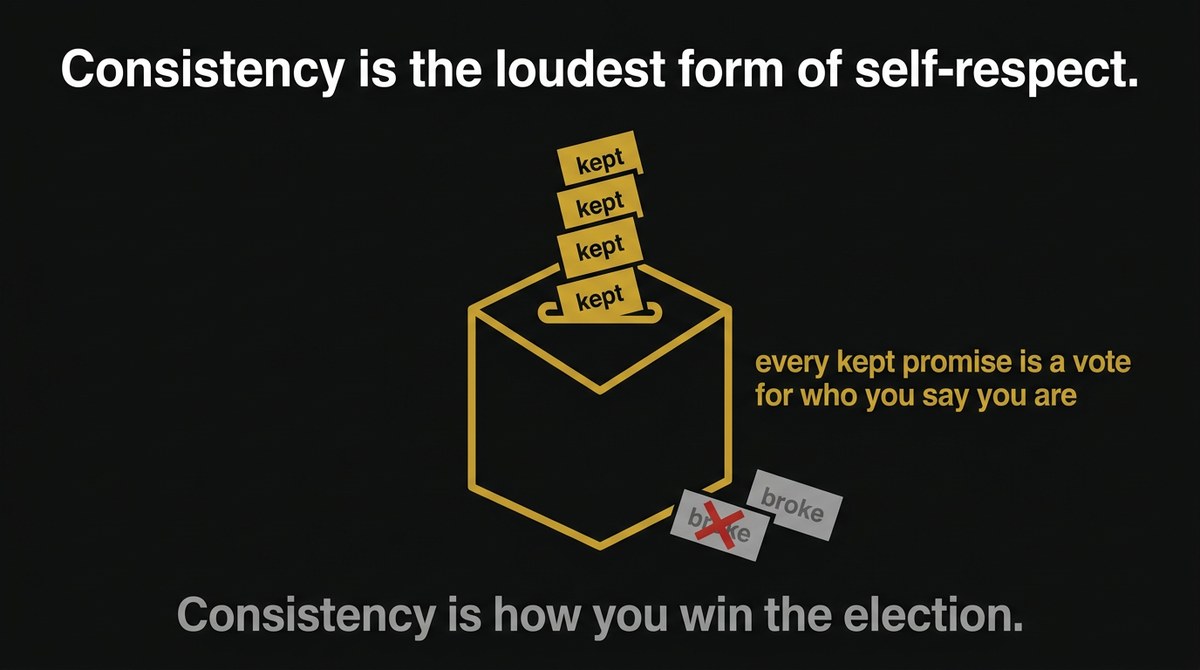
Consistency Is the Loudest Form of Self-Respect
3 min read
You can tell people you respect yourself. You can write it in a journal, say it in the mirror, believe it sincerely. And then you can watch what you actually do when you told yourself you would train at six and it is six, when you said no more of that and it is in front of you, when you promised yourself the difficult thing would happen this week and it is Friday. The body keeps score of these moments, and its scorecard is the only definition of self-respect that holds up. Consistency is not a productivity technique. It is what respecting yourself looks like from the outside.
The Promises Nobody Else Sees
Break a promise to a friend and there are consequences: an apology, a repair, a small loss of trust. Break a promise to yourself and there is silence. No one knows, no one is disappointed, nothing visibly happens. That silence is deceptive. Each broken self-promise deposits a quiet piece of evidence that your word to yourself means nothing, and over years that evidence becomes a belief, and the belief becomes a life in which you no longer expect yourself to follow through. The damage is invisible and total.
Why Consistency Repairs It
The same mechanism runs in reverse. Every kept promise, however small, is a deposit of the opposite evidence: I said I would and I did. Repeat it enough and the belief flips. You begin to trust yourself the way you trust a reliable friend, and that trust changes what you are willing to attempt, because you now expect to actually do what you set out to do. Consistency does not just produce results. It produces a self you can count on, which is the precondition for every result.
 Worth reading on thisMan’s Search for Meaning by Viktor E. Frankl — Written by a man who lost everything and kept the one thing that mattered. Read it slowly.Click hereto see it→
Keeping Your Word to Yourself
Promise less
Most self-betrayal comes from overpromising. Ten minutes kept beats an hour intended. Set the commitment at a level you will honor on your worst day, then honor it.
Treat the appointment with yourself as real
You would not skip a meeting with someone you respected because you did not feel like it. Extend yourself the same courtesy. The six o’clock session is a meeting. Attend it.
Notice the moment of negotiation
There is always a moment where a voice offers a reasonable exception. Recognize it as the moment the vote is cast, and cast it for the person you are building.
 Goes deeperAtomic Habits by James Clear — The clearest manual on making a habit small enough to survive a bad week. Pairs with almost everything on this site.Click hereto see it→
Repair quickly when you slip
One missed day is a slip. Two is the beginning of a new pattern. The consistency that matters is not perfection. It is how fast you return.
What It Becomes
Over time, consistency stops feeling like discipline and starts feeling like identity. You are not forcing yourself to train; you are someone who trains. You are not resisting the thing; you are someone who does not do that anymore. The effort migrates from willpower to self-image, and self-image is nearly effortless to maintain. That is the destination: a life where keeping your word to yourself is simply who you are, and the respect follows automatically.
Cast the Vote
Whatever you promised yourself this week, keep it today, at the size you can honor, without negotiation. Nobody else will see it. You will, and you are the only audience whose opinion of you actually runs your life.
Two more books, and one tool

Launch list
Be there on day one.
One email when the book opens on Kickstarter. Nothing else. Already reading the book? Your Cheat Sheet is at wisdomdeck.com/free.
Coming soon on 
The book itself — 40 laws in ten parts, 320 pages, each ending with The Work — is funded first on Kickstarter.
