Radical Acceptance by Tara Brach: What It Teaches, Who It’s For, Who Should Skip It
3 min read
As an Amazon Associate we earn from qualifying purchases. Nobody paid to be on this page — no author, no publisher. This is our plain-language overview of what the book argues, who it suits and who should skip it, so you can decide in two minutes whether it deserves a place on your shelf.
Click hereto see it→Click to see Radical Acceptance
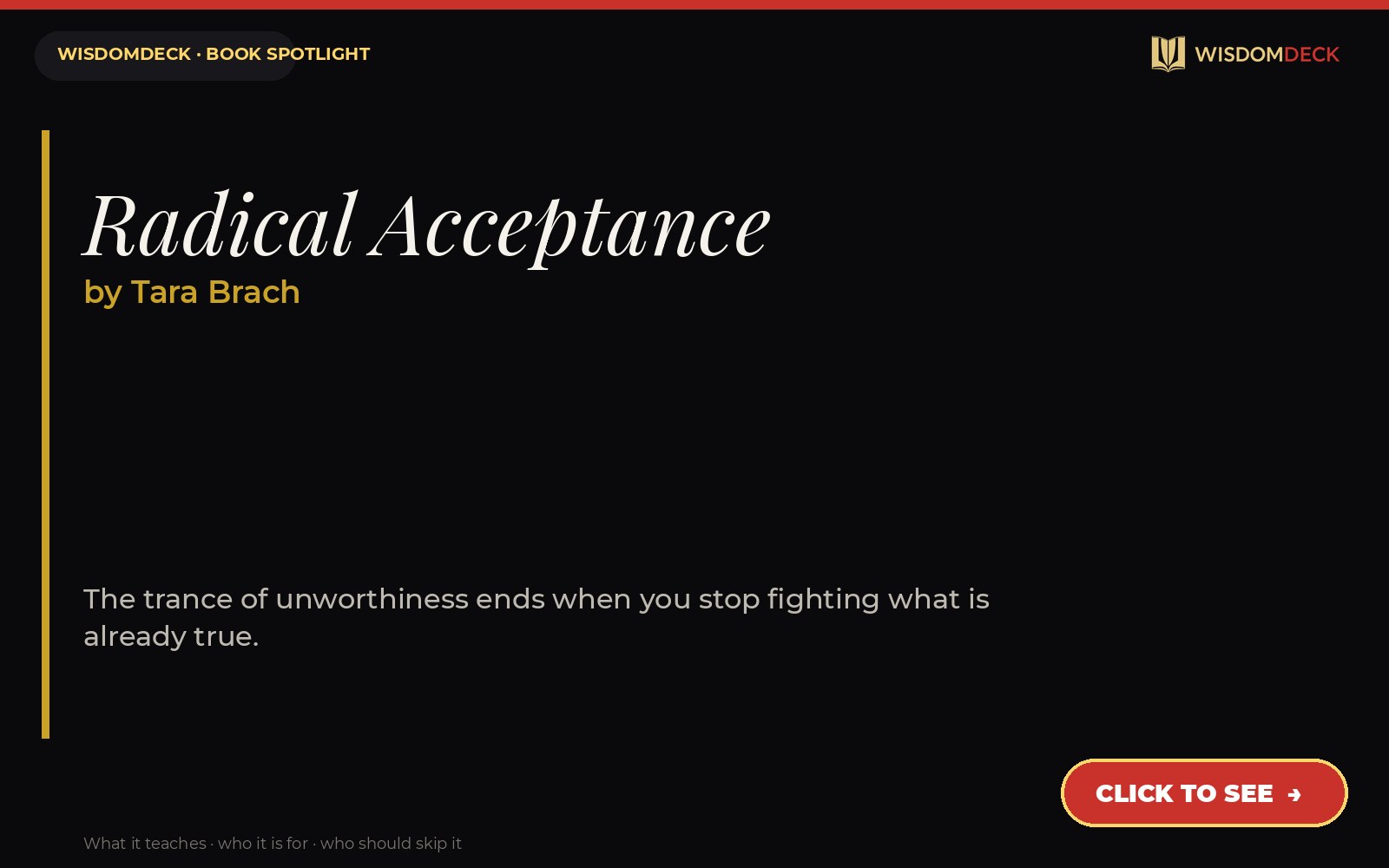
The trance of unworthiness ends when you stop fighting what is already true.
What the book argues
Most suffering comes from the belief that something is wrong with us. Brach, a psychologist and meditation teacher, combines Buddhist practice with clinical insight to teach radical acceptance: meeting each moment, and yourself, with clear recognition and compassion.
Three ideas you can use this week
- Pause: the sacred pause interrupts reactivity and lets you choose.
- Name what is present (fear, shame, anger) and let it be without acting or suppressing.
- Self-compassion is not indulgence; it is the ground from which change becomes possible.
Who it is for
Perfectionists, harsh self-critics and anyone whose inner voice would get them fired if it were a colleague.
How to turn it into a routine
Three times a day, take a thirty-second pause: feel the body, name the emotion, breathe, continue.
Who should skip it
Readers who want secular, data-driven material may find the Buddhist framing and personal stories heavy.
Verdict
A gentle, deep book that many people return to for years. Best read slowly with the practices.
Click hereto see it→Click to see Radical Acceptance
If you liked the sound of this
How to Stop Worrying and Start Living by Dale Carnegie
Carnegie’s other classic, and for many readers the more useful one.
Stumbling on Happiness by Daniel Gilbert
Why we are so bad at predicting what will make us happy, by a Harvard psychologist with a sense of humor.
Tools that put the book to work
Reading is the easy part. Three simple tools that turn the idea into a daily routine:
Gratitude Journal
Three lines a night. The cheapest mood tool that actually works. Read our review.
Five-Minute Morning Journal
Three prompts in the morning, two at night. The frame your day hangs on. Read our review.
Weighted Blanket
Deep pressure, deeper sleep. The body calms before the mind agrees to. Read our review.
Links are affiliate links; the price to you is identical. Nothing here is medical, financial or professional advice. Filed under Gratitude & Inner Peace.
More picks, with pictures
Three tools and three books that fit the same goal. Each has its own full review here, including who should skip it.
As an Amazon Associate we earn from qualifying purchases. Images are our own review cards, not product photos.



Launch list
Be there on day one.
One email when the book opens on Kickstarter. Nothing else. Already reading the book? Your Cheat Sheet is at wisdomdeck.com/free.
Coming soon on 
The book itself — 40 laws in ten parts, 320 pages, each ending with The Work — is funded first on Kickstarter.