

Cable Labels Before You Unplug: Know Which Cord Belongs to What
3 min read
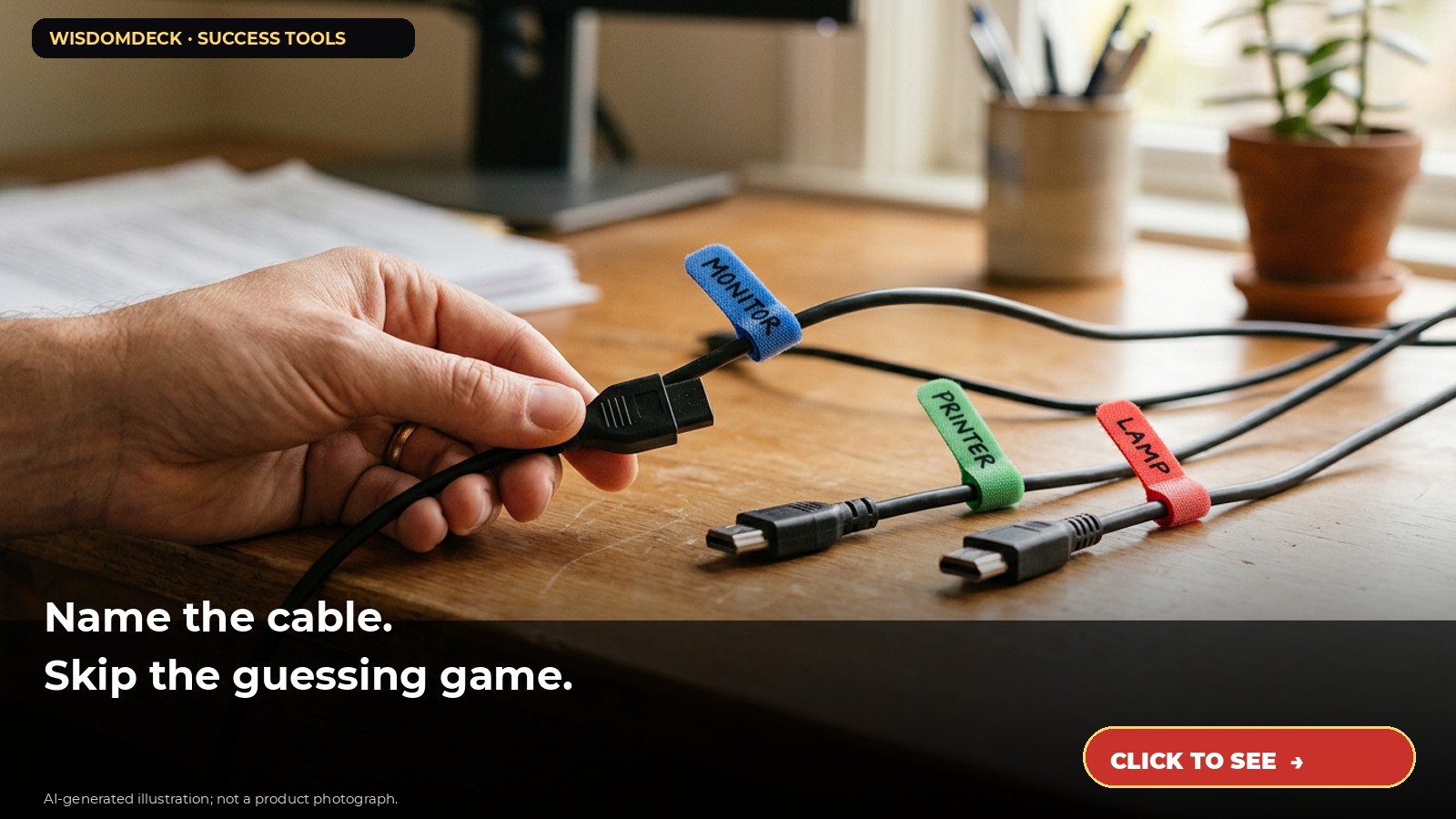
We may earn a commission if you buy through this link.
See Wrap-It Storage reusable cable labels on Amazon. Check the current listing before buying; existing supplies may be all you need.
Three black cables disappear behind the desk. You want to move one device, but the plugs look similar and the destination is out of sight. Pulling a random plug is not a reliable identification method, especially while equipment is working.
A cable label gives a lead a readable identity. It does not tell you whether a connection is electrically safe or which cable is compatible with a device. Use it as an organizational aid, alongside the equipment instructions.
Start with one small group
Choose ordinary accessible desk equipment rather than opening electrical panels or reaching into an unsafe space. Save your work and follow the relevant shutdown instructions before disconnecting anything. Leave hardwired, damaged, hot, inaccessible, or unfamiliar connections to an appropriate professional.
Trace one cable at a time while both ends are visible. Do not assume that two similar connectors serve the same purpose. If a lead cannot be identified confidently, mark it as unidentified and investigate without experimenting on important equipment.
Use names that answer a question
Write the device name and, where useful, the connection: “Monitor power” or “Printer USB.” A label saying “Cable 3” adds little unless a matching list is maintained nearby. Use names that another person in the space can understand.
If two devices share a name, add their location or a short identifier. Avoid putting passwords, private network information, or personal details on visible labels. A simple identity usually provides enough information.
Label both ends when practical
The end beside the device and the end beside the connection point answer different questions. Matching labels can help you reconnect after moving a desk. Place them where they are readable without pulling on the cord or covering manufacturer warnings.
Keep labels clear of vents, moving parts, connectors, and any location the manufacturer says must remain unobstructed. A label should not create strain on a plug or require a sharp cable bend. Follow the label maker’s application instructions as well as the equipment guidance.
Make color a backup, not the whole system
Color can help distinguish several leads quickly, but it should support written names rather than replace them. Lighting, similar shades, and different color perception can make a color-only system difficult to interpret.
For example, a blue tag might help you spot a monitor lead, while the words “Monitor power” establish its meaning. If the device changes, update the name immediately instead of expecting everyone to remember the old assignment.
Leave a simple reconnection record
Before rearranging a group of cables, photograph the ordinary accessible connections if doing so is permitted. Exclude confidential screens and identifying details. Store the picture somewhere you can find it without the equipment you are disconnecting.
After reconnecting, check the equipment through its normal startup process. A label or picture is a reference, not proof that a connection is correct. Do not force a connector that does not fit normally.
Who can skip buying labels
If you have only one obvious cable, another accessory may add no value. Existing suitable tags may work. Reusable labels are worth considering when devices move or assignments change, but no specific brand is necessary to test the idea.
The useful result is a readable answer to “what does this belong to?” It is not a promise of better device performance or a substitute for electrical safety.

Launch list
Be there on day one.
One email when the book opens on Kickstarter. Nothing else. Already reading the book? Your Cheat Sheet is at wisdomdeck.com/free.
Coming soon on 
The book itself — 40 laws in ten parts, 320 pages, each ending with The Work — is funded first on Kickstarter.


