Keep a Decision Receipt Before You Know How It Turns Out
3 min read
A choice can be sensible when you make it and still turn out badly. Another choice can be poorly considered and get lucky. If you judge only the outcome, it becomes difficult to tell which habits are worth repeating.
A decision receipt is a short record made before the result arrives. It is not a prediction system. It gives your future self something more reliable than an edited memory of what you thought at the time.
Choose a decision worth recording
Start with a reversible, ordinary decision: which skill to practice this month, whether to take on a small project, or which approach to try with a recurring work problem. Do not turn every purchase or lunch choice into paperwork.
For legal, medical, or major financial decisions, a card is not a substitute for appropriate professional advice. The method here is a reflection tool, not a recommendation about what decision to make.
Write five lines before acting
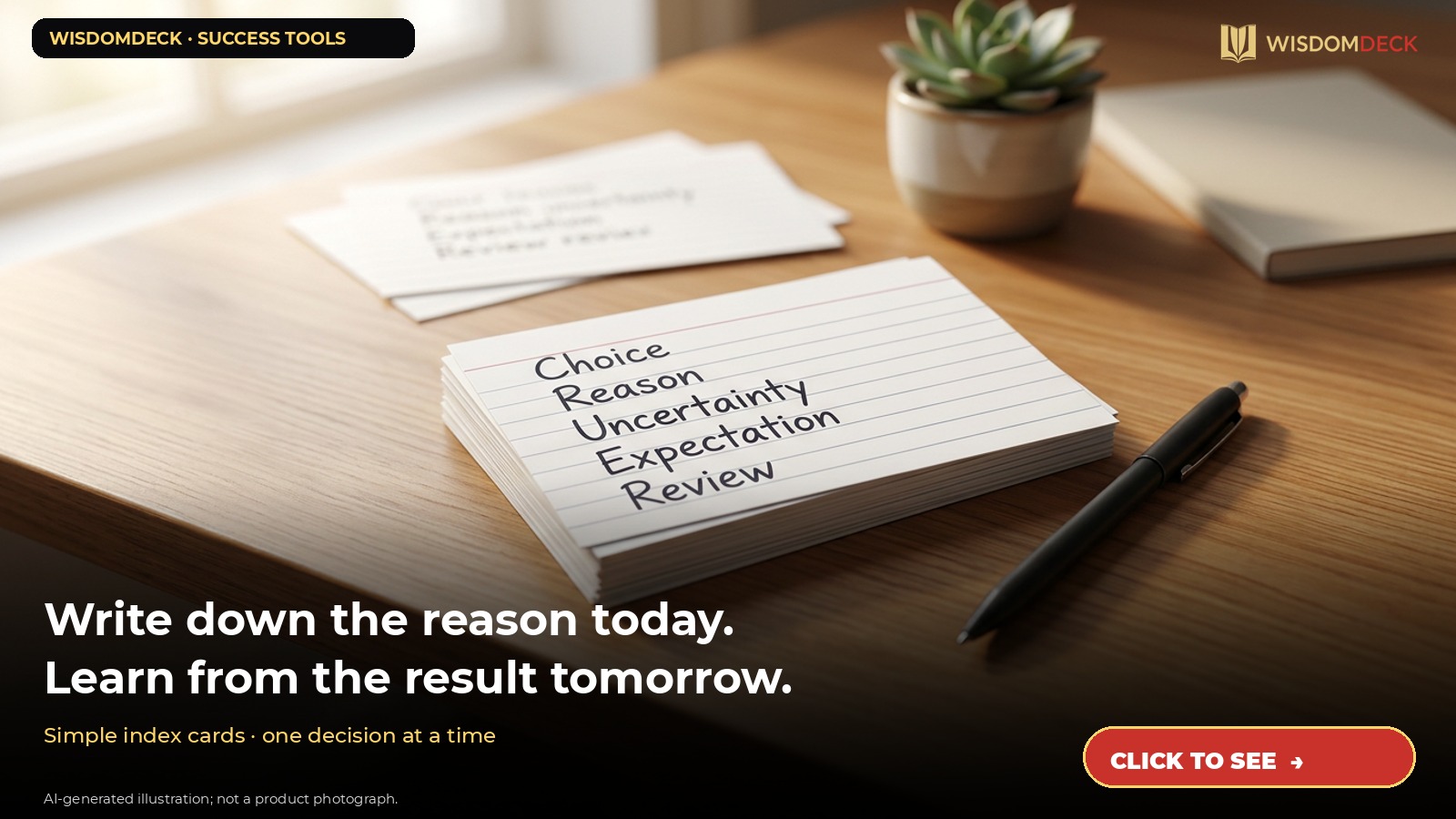
- Choice: What am I actually deciding?
- Reason: What information supports this option?
- Uncertainty: What important thing do I not know?
- Expectation: What observable result would make this worth continuing?
- Review: When will I look again, and what would make me stop sooner?
Keep the language concrete. “This will improve my life” cannot be checked easily. “I will complete three practice sessions before deciding whether to continue” gives you something observable.
An example: testing a learning routine
Suppose you want to practice spreadsheet skills before applying for a different role. Your choice might be two short practice sessions each week for a month. Your reason is that you can already identify recurring spreadsheet tasks in roles that interest you. Your uncertainty is whether the course exercises resemble useful work.
The expectation could be completing one small spreadsheet without following a tutorial line by line. At review time, you assess what you can do, not merely whether you watched the lessons. If the exercises are irrelevant, changing materials may make more sense than declaring yourself incapable.
Review the reasoning separately from the result
When the review date arrives, add three notes: what happened, what surprised you, and what you would change about the decision process. Ask whether your original assumption was reasonable given the evidence available then.
A bad result does not automatically prove the reasoning was bad. But “I could not have known” is not a reason to ignore information you could reasonably have checked. The receipt makes that distinction easier to discuss honestly.
Do not build a museum of old choices
Keep only decisions you are willing to revisit. If every card becomes another obligation, use one page in a notebook instead. The useful part is recording your reasoning before hindsight arrives—not maintaining an impressive collection.
We may earn a commission if you buy through this link.
Optional supply: Oxford 3 × 5 ruled index cards on Amazon. The listing identifies a 100-card pack. Any spare paper works for this exercise; buy cards only if the format is useful to you. Check the current listing for pack details and availability.
Try it today
Pick one small decision you are already about to make. Write the five lines, choose a review date, and put the note where you will see it. The goal is not to become certain. It is to learn more honestly from what happens next.

Launch list
Be there on day one.
One email when the book opens on Kickstarter. Nothing else. Already reading the book? Your Cheat Sheet is at wisdomdeck.com/free.
Coming soon on 
The book itself — 40 laws in ten parts, 320 pages, each ending with The Work — is funded first on Kickstarter.