

A Practice Notebook That Records Corrections, Not Just Hours
3 min read
We may earn a commission if you buy through this link.
See Amazon Basics classic lined notebook on Amazon. Check the current listing before buying; existing supplies may be all you need.
Writing “practiced for thirty minutes” records attendance. It does not tell you what became clearer, which mistake kept returning, or what to attempt next. If you are learning a practical skill, a short correction log can make the next practice session more specific.
A lined notebook is one way to keep that log. The useful part is not the cover or paper count. It is the distinction between an attempt, an observed problem, and a correction you can actually try.
Choose one narrow skill
Start with something small enough to observe: building a spreadsheet formula, explaining a concept aloud, typing a particular symbol sequence, or writing a clear opening paragraph. “Become better at work” is too broad to guide a useful entry.
Define what a satisfactory attempt would look like. For a formula exercise, the result might need to match a supplied answer. For an explanation, you might ask a listener to restate the main point. A clear check is more useful than judging yourself as talented or untalented.
Record the attempt without grading your character
Write the date, the exercise, and the result you observed. “The total included the heading row” identifies a fixable issue. “I am hopeless with spreadsheets” does not describe the work precisely enough to improve it.
Keep the entry factual. If you are unsure what went wrong, say so and name the evidence you need. A notebook should not turn a guess into a confident diagnosis of your performance.
Separate the correction from the observation
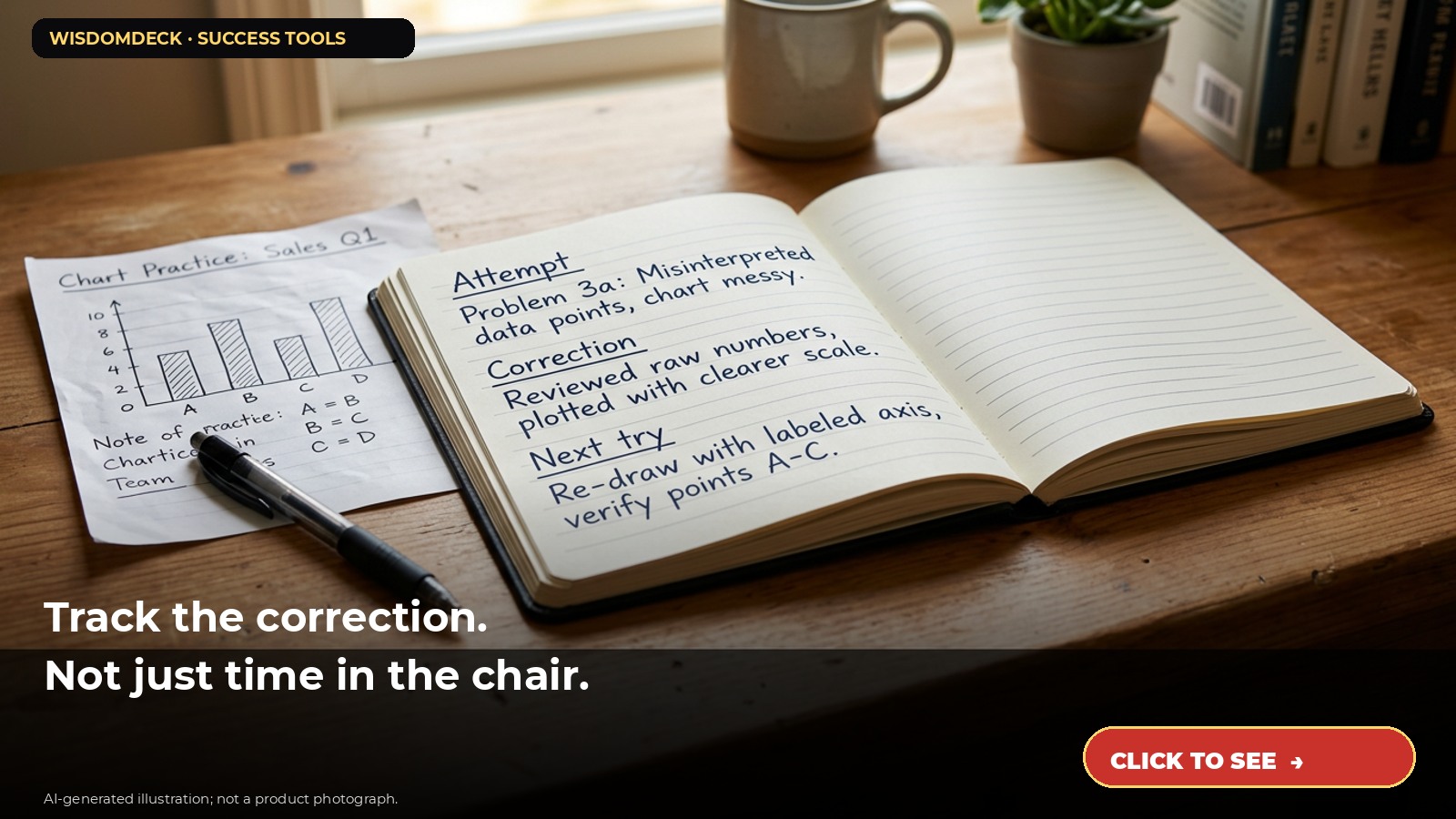
Use three headings: Attempt, Correction, Next try. Under Correction, write the change you intend to make and where it came from. That might be an instructor’s feedback, a reliable worked example, or the software’s documentation.
For example, the attempt used the wrong cell range. The correction is to start the range below the heading. The next try is a fresh exercise with a different number of rows. Copying the corrected answer alone would not show whether you can apply the idea again.
Retry before adding another lesson
Use the previous entry to choose the first exercise next time. Check whether the correction transfers to a new example. If the same problem returns, make the exercise simpler or seek appropriate feedback rather than repeating an unclear instruction indefinitely.
Keep successful corrections too. A short note about what worked can prevent you from replacing a useful method merely because it no longer feels new. The goal is a usable record, not a page full of mistakes.
Review for patterns occasionally
After several sessions, look for a repeated category of error. Perhaps you rush the final check, misunderstand the instruction, or skip a necessary preliminary step. Choose one pattern to address. Do not build an elaborate scoring system unless those numbers will change how you practice.
Practice logs cannot replace qualified instruction for dangerous tasks or regulated work. Follow relevant safety rules and training requirements. Do not experiment with electrical, medical, or other hazardous procedures based on a notebook entry.
Who should skip a dedicated notebook
Use a document or existing notebook if it already works. If an instructor provides a required log, avoid duplicating it. Keep confidential work examples out of personal records unless you have permission to store them.
A useful first entry can be only a few lines. Write what happened, the correction you will test, and the next attempt. That is enough to make the record serve practice rather than replace it.

Launch list
Be there on day one.
One email when the book opens on Kickstarter. Nothing else. Already reading the book? Your Cheat Sheet is at wisdomdeck.com/free.
Coming soon on 
The book itself — 40 laws in ten parts, 320 pages, each ending with The Work — is funded first on Kickstarter.
