Sticky Notes for a Restart Cue: Leave the Next Move Before You Stop
3 min read
We may earn a commission if you buy through this link.
See Amazon Basics lined sticky notes on Amazon. Check the current listing before buying; existing supplies may be all you need.
You return to a piece of work and know what it is, but not where to begin. The document is open, the tabs are still there, and the last few minutes of reasoning are missing. A task label such as “finish spreadsheet” identifies the project without restoring your place inside it.
A restart cue is a short instruction written before you stop. It gives your next session a concrete first move. A sticky note can keep that cue near the work, although a plain document comment or digital note may be a better choice for some tasks.
Write an action, a location, and a question
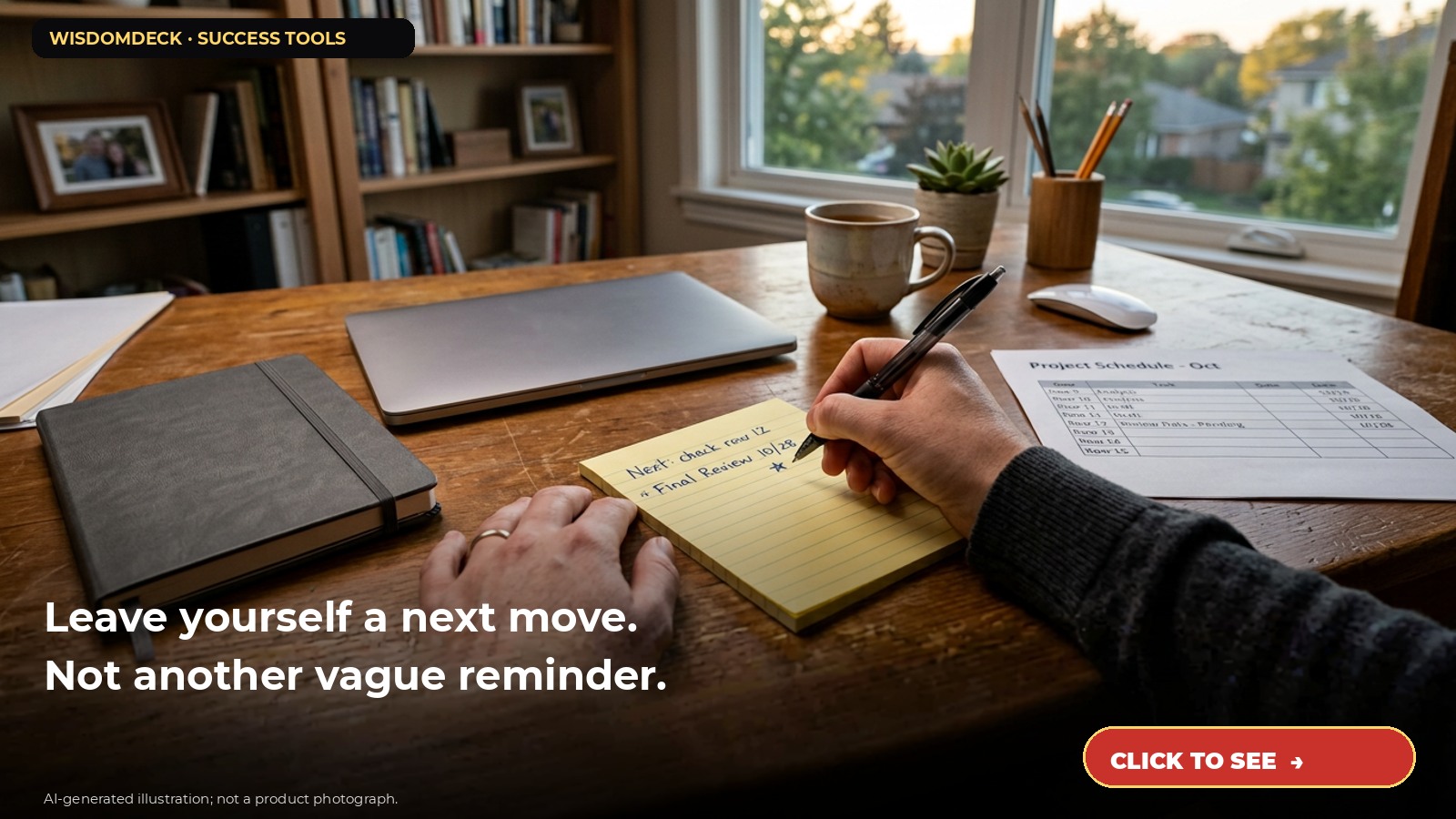
Start with a verb: compare, calculate, replace, check, draft. Add the exact location, such as a page, section, file, or row. Then record the unresolved question if there is one. “Check row 12 against the source invoice; shipping may be counted twice” is more useful than “sort out numbers.”
You are not writing a full account of the session. Record only what another version of you would otherwise have to rediscover. If the cue grows into a page of explanation, put the detail in the project file and leave a short pointer.
Use the last minute before a planned stop
When you know you are about to leave, save the work first. Then write the cue while the context is still available. Include the current file name or version if there is a realistic risk of opening the wrong one next time.
An unexpected interruption will not always allow this routine. If you must leave immediately, prioritize safety and the situation in front of you. A helpful work habit should not become a reason to ignore something more important.
Place the note where restarting happens
Put the cue on the relevant notebook cover, beside the keyboard, or in the project’s approved digital system. Do not build a wall of notes competing for attention. One active cue per stopped task is usually easier to interpret than a collection of old instructions.
Check whether an adhesive is suitable for the surface before applying it. Avoid covering ventilation, placing notes inside equipment, or attaching them to delicate materials. A loose index card can serve the same purpose without adhesive.
Use the cue, then retire it
At the next session, confirm that the instruction still makes sense. Requirements may have changed while you were away. If it remains relevant, perform the small first action and continue. When it is no longer useful, remove it or replace it with the next cue.
For example, a draft may have paused at a missing reference. The cue names the paragraph and the source to inspect. Once you resolve that reference, discard the note rather than leaving a completed instruction beside the work.
When paper is the wrong place
Do not put passwords, customer details, private records, or other sensitive information on a visible desk note. Shared projects generally need cues in the team’s agreed system, where another person can find them. A private sticky note is not a reliable substitute for a handoff.
Try the routine with paper you already have before buying a pack. This is an organizational technique, not a treatment or a guarantee of focus. Its value is narrower: leaving a usable starting point when you already know what comes next.

Launch list
Be there on day one.
One email when the book opens on Kickstarter. Nothing else. Already reading the book? Your Cheat Sheet is at wisdomdeck.com/free.
Coming soon on 
The book itself — 40 laws in ten parts, 320 pages, each ending with The Work — is funded first on Kickstarter.