

Turn a Work Project Into a Portfolio Case Study Without Overclaiming
2 min read
AI transparency: This article was created with AI assistance. It is general organizational information, not a personal product review or professional advice.
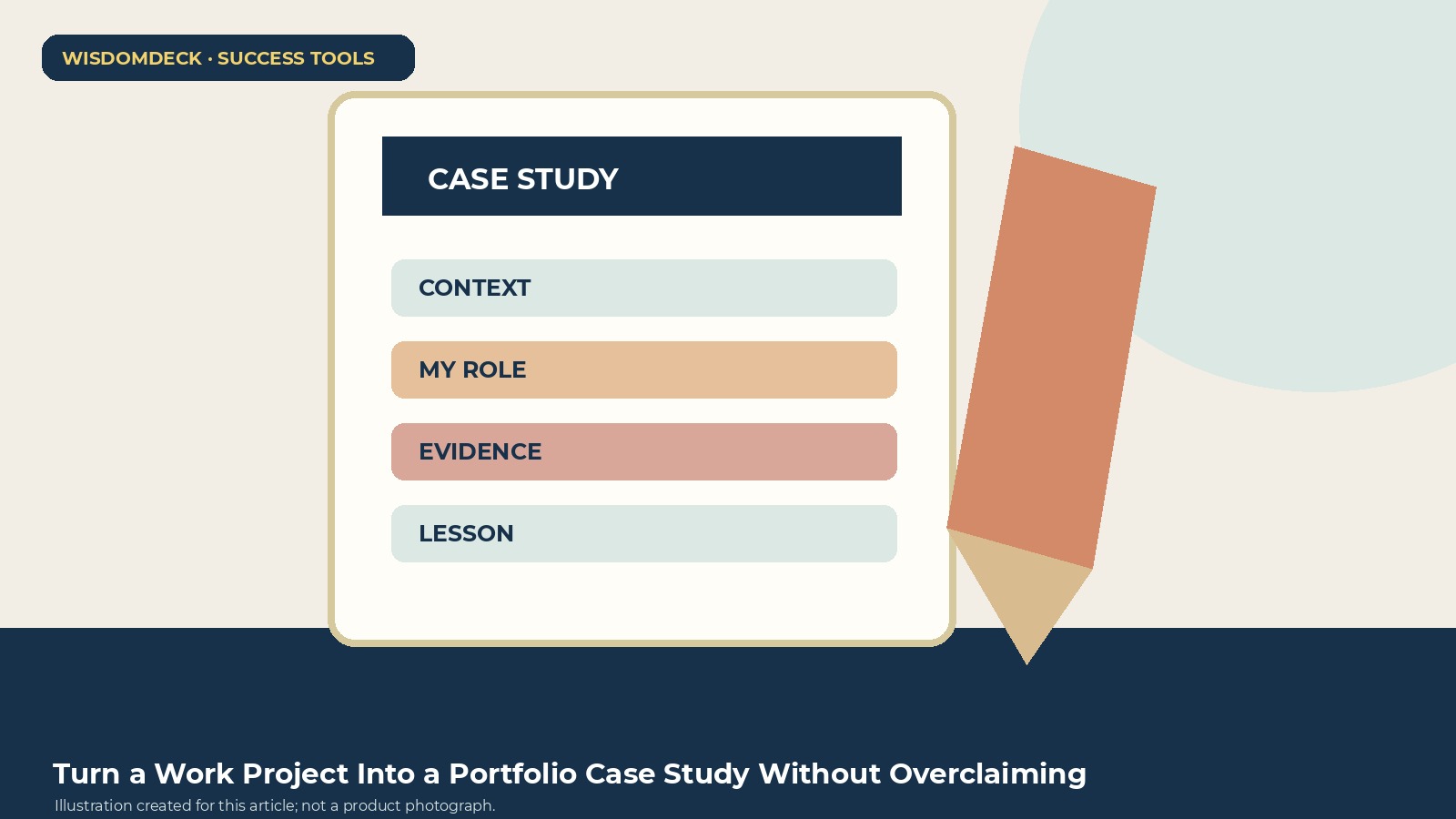
A portfolio case study can help explain how you approach work, not just list the final result. A clear account distinguishes your contribution from the team’s, uses evidence you are allowed to share, and names what you learned. It should not expose confidential information or claim outcomes you cannot support.
Start with a safe, accurate summary
Describe the project in a few lines: the setting, the challenge, and the broad goal. Remove client names, private data, internal figures, and identifying details unless you have explicit permission to use them. Follow employer, client, and contract rules. When in doubt, ask the appropriate person before publishing.
You can use a generalized description such as “a regional service team needed a clearer intake process” rather than naming an organization or reproducing its internal documents.
 Worth reading on thisEssentialism by Greg McKeown — Doing fewer things, on purpose. The best argument for a shorter list you will read.Click hereto see it→
Separate the team result from your role
State who was involved and what you personally owned. Use verbs that fit your actual contribution: coordinated, drafted, analyzed, tested, or supported. Do not imply sole ownership of a group result. If your role changed during the work, explain that briefly.
A simple structure is: “The team did X; I was responsible for Y; I worked with Z.” This makes collaboration visible while still giving readers a concrete picture of your skills.
Show evidence, not adjectives
Replace claims like “excellent communicator” with a specific, permitted example: a decision log you maintained, a handoff you clarified, or feedback you incorporated. If you have a metric, verify its source, timeframe, and meaning before including it. Do not invent a percentage or imply that one action caused a result without evidence.
When quantitative details are confidential, describe the process or use an approved, non-identifying range. If no metric is available, a clear artifact or explanation of your reasoning can still demonstrate the work.
 Goes deeperAtomic Habits by James Clear — The clearest manual on making a habit small enough to survive a bad week. Pairs with almost everything on this site.Click hereto see it→
Explain a decision and a lesson
Choose one meaningful decision. Describe the options you considered, the constraint that mattered, and why the selected approach made sense. Then name one thing you would repeat or change next time. A grounded lesson is more useful than presenting the project as flawless.
Review it before sharing
Check permissions, names, dates, links, and every factual claim. Ask a trusted reviewer to flag ambiguity, not to embellish the story. Keep a private source note for facts you may need to verify later, then store it securely and according to applicable rules.
A strong case study is accurate, concise, and respectful of the people who did the work. Start with one project you can discuss safely, write a short draft, and remove anything you cannot substantiate or share.
Keep a source trail for yourself
While drafting, note where each date, result, and description came from. The notes do not all belong in the public case study, but they help you confirm details later and distinguish memory from evidence. Store them in an approved private location, especially when project materials are subject to confidentiality rules.
Two more books, and one tool

Launch list
Be there on day one.
One email when the book opens on Kickstarter. Nothing else. Already reading the book? Your Cheat Sheet is at wisdomdeck.com/free.
Coming soon on 
The book itself — 40 laws in ten parts, 320 pages, each ending with The Work — is funded first on Kickstarter.


