300 Colored Index Cards Review: The Oldest Study Tool Still Beats the Apps
3 min read
As an Amazon Associate we earn from qualifying purchases. Nobody paid to be on this page; we only list what we would hand to a friend. We have not laboratory-tested these items — we read the specifications and hundreds of buyer reviews, praise and complaints alike, and chose accordingly.
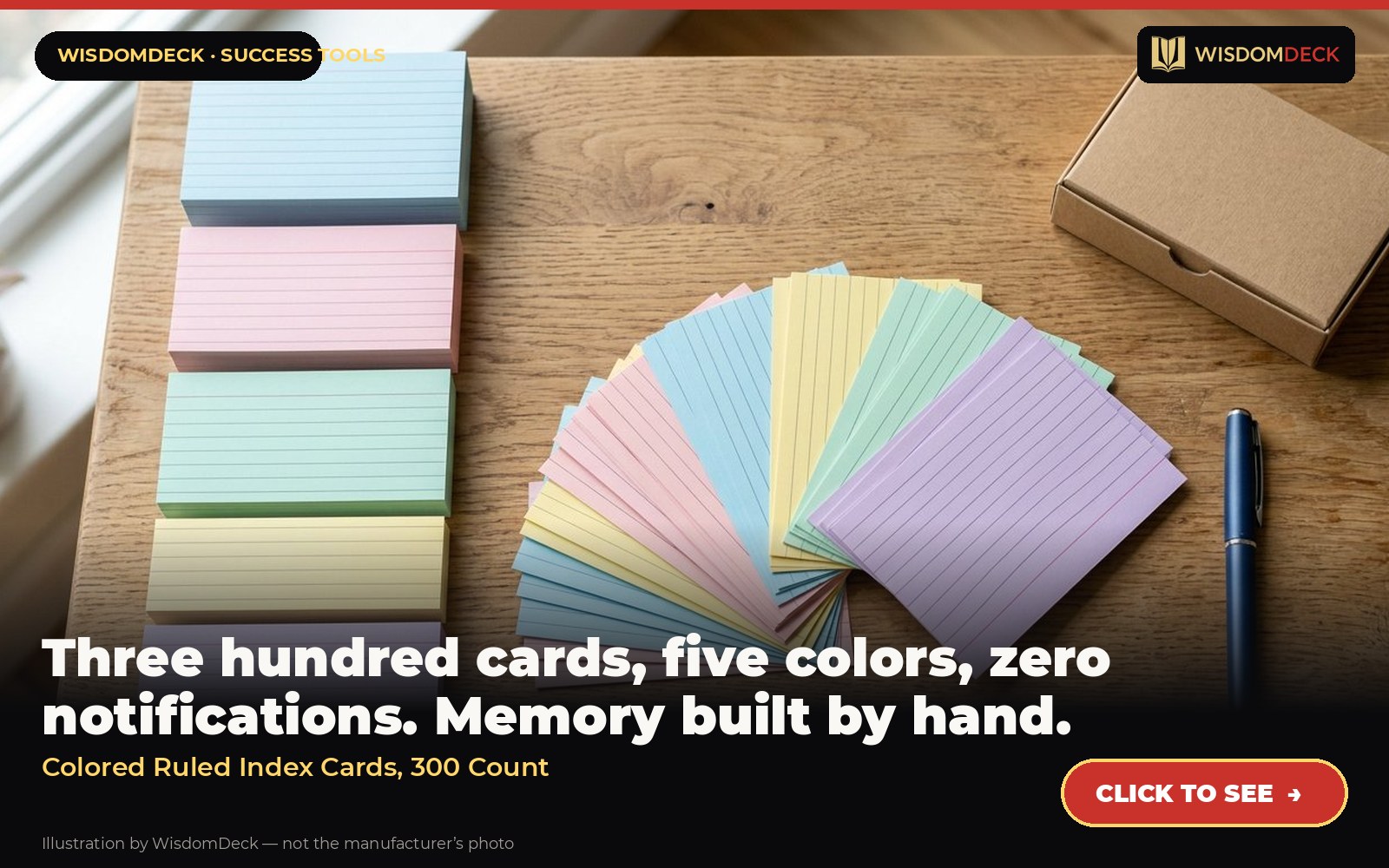
Click hereto see it→Click to see the Colored Ruled Index Cards, 300 Count
Three hundred cards, five colors, zero notifications. Memory built by hand.
The problem it solves
Flashcard apps work until the phone offers something more interesting. Paper cards force you to write the question, which is half the learning, and color lets you separate subjects or difficulty at a glance. Spaced repetition needs nothing more than a shoebox and three dividers.
What it is
Three hundred ruled 3 by 5 index cards in five colors.
From the manufacturer’s own listing, the features that matter:
- Bulk Value Pack & Organization Efficiency: Get 6 packs of 50 sheets each (300 total) colored ruled index cards. Thick paper resists bleeding and curling, ideal for highlighters, pens, and markers
- High-Density Paper Cardstock: Ensures smudge-proof writing. Acid-free 160gsm paper prevents ink bleed-through while providing satisfying tactile feedback. Perfect for fountain pens,gel pens & markers
- Multi-Purpose Flash Cards: Adaptable for study aids, quick jotting, or visual organization. These 3×5 index cards simplify information retention across work, education, and personal projects
- Smooth Writing Surface: With subtle guidelines silky-coated surface enables effortless pen gliding. Perfect for students, bullet journalists & meeting note-takers
- Effortless Organization: Optimized for creating flashcards, study notes, project planning, etc. Our index cards help categorize subjects or business projects with intuitive visual system
Who it is for
Spaced-repetition learners, speech planners and people who think one idea per card.
How to use it in a routine that sticks
One fact per card, question on the front, answer on the back, written in your own words. Three boxes: daily, every three days, weekly; a card moves up when you get it right and back to daily when you miss. Ten minutes a day, logged on the planner page.
What buyers say
Praise. Buyers like the color coding and the card stock weight.
Complaints. No box included; buy a card case.
Who should skip it
If you need audio or images in your cards, an app does that better. Thick cards fill a box fast; buy a card box at the same time.
Alternatives worth a look
- BIC Brite Liner Highlighters — students and readers who mark up what they want to remember.
- Avery Big Tab Write & Erase Dividers — binder-based planners, students and anyone organizing a course or project.
Verdict
The highest return per dollar of anything in the learning category.
Click hereto see it→Click to see the Colored Ruled Index Cards, 300 Count
Two books to go with it
Sapiens by Yuval Noah Harari
Big-picture perspective for when your own problems feel too large.
Sapiens (paperback) Click hereto see it→
Ultralearning by Scott H. Young
How to learn hard things quickly and deliberately.
Ultralearning (paperback) Click hereto see it→
Links are affiliate links; the price to you is identical. Nothing here is medical or professional advice; these are tools for learning routines, not treatments.
More picks, with pictures
Three tools and three books that fit the same goal. Each has its own full review here, including who should skip it.
As an Amazon Associate we earn from qualifying purchases. Images are our own review cards, not product photos.







Launch list
Be there on day one.
One email when the book opens on Kickstarter. Nothing else. Already reading the book? Your Cheat Sheet is at wisdomdeck.com/free.
Coming soon on 
The book itself — 40 laws in ten parts, 320 pages, each ending with The Work — is funded first on Kickstarter.