

A Job Search Tracker That Turns Applications Into Clear Next Steps
3 min read
AI transparency: This article was created with AI assistance. It is general organizational information, not a personal product review or professional advice.
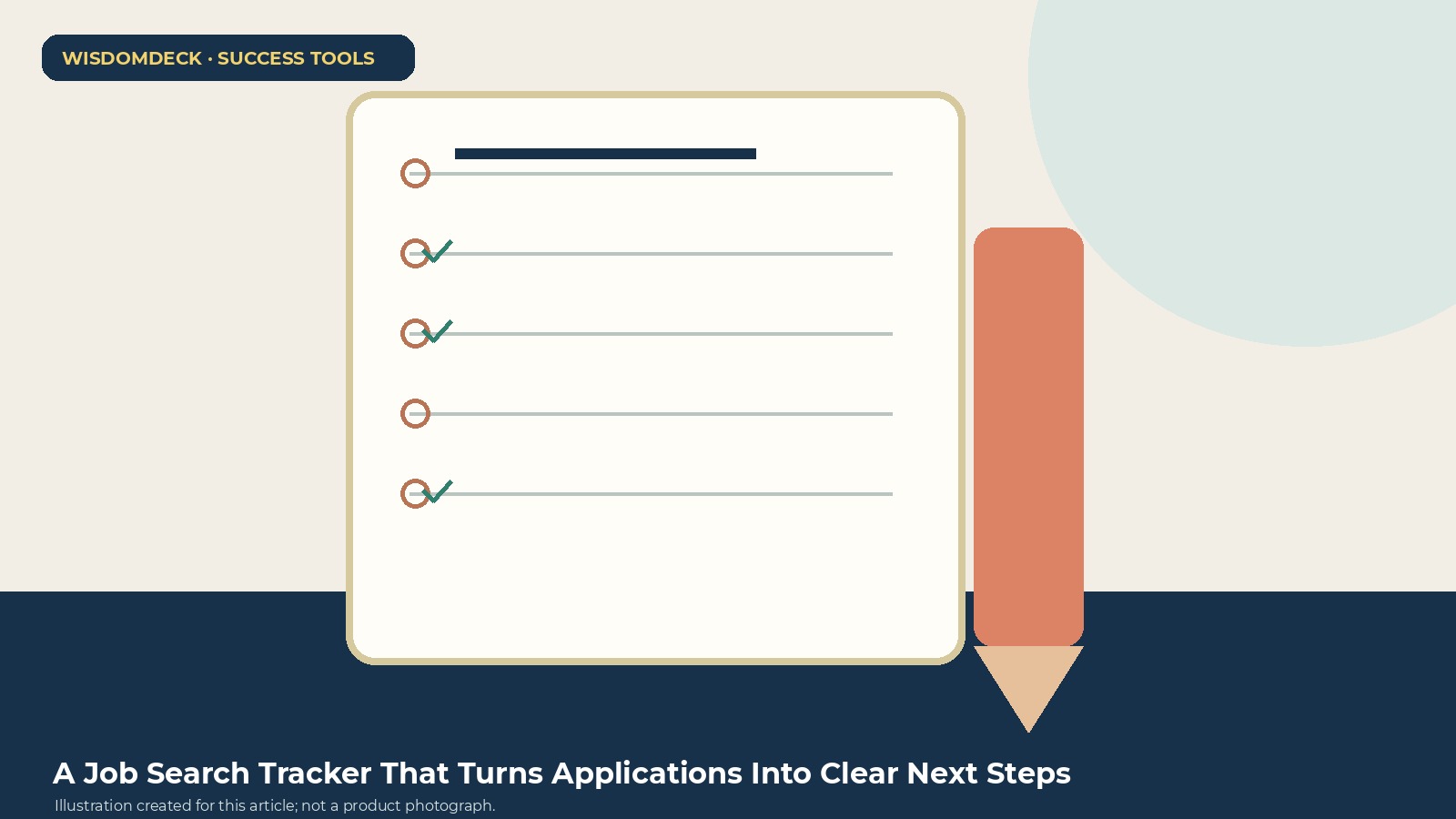
A job search can create many open loops: roles to compare, applications to finish, conversations to follow up on, and deadlines to remember. A simple tracker makes those commitments visible. It cannot guarantee an interview or offer, but it can help you decide what to do next without rereading every note.
Track only details that change your next move
Start with a spreadsheet, notebook, or document you already use. For each opportunity, record the organization, role, source, date found, application deadline, status, and next action. Add a contact or follow-up date only when it is relevant. Avoid collecting personal information you do not need.
Use short status labels such as “review,” “tailor,” “submitted,” “conversation,” and “closed.” Define them once so that “in progress” does not become a catch-all for everything.
 Worth reading on thisEssentialism by Greg McKeown — Doing fewer things, on purpose. The best argument for a shorter list you will read.Click hereto see it→
Convert vague intentions into actions
“Work on applications” is hard to start. A next action names a visible step: compare the role requirements with your résumé, draft one project example, or submit the completed form. When another person or organization must respond, record what you are waiting for and when you will check again.
For example, if a posting closes Friday, your plan might be: shortlist the role Monday, tailor the résumé Tuesday, ask a trusted person to review one section Wednesday, and submit Thursday. Those dates are an illustration, not a universal schedule. Adjust them to the actual deadline and your capacity.
Use a short review rhythm
Choose a regular time to review the tracker—perhaps twice a week. First check deadlines and scheduled conversations. Then choose a small number of actions that fit the time available. Update the status immediately after a submission or conversation, while the details are fresh.
If the tracker grows discouraging, reduce its fields. Keep closed opportunities for reference only if that is useful, or archive them. The purpose is to support decisions, not to score your worth by the number of rows.
 Goes deeperAtomic Habits by James Clear — The clearest manual on making a habit small enough to survive a bad week. Pairs with almost everything on this site.Click hereto see it→
Protect your energy and information
Set a stopping point for each work session. A focused block to prepare one application may be more manageable than an open-ended search session. Take breaks and seek support from qualified career services when useful. Do not share sensitive personal details in a public file or an unsecured document.
Review application instructions directly on the employer’s current site. A tracker is a memory aid, not proof that a role is still open or that your materials meet every requirement.
Start with one opportunity
Create a row for one role you are genuinely considering. Write the deadline, the next action, and when you will take it. If the role is no longer a fit, close it deliberately and move on. A useful tracker helps you spend attention on the next meaningful step—not on maintaining a perfect system.
Keep the process sustainable
Decide how many applications you can prepare thoughtfully in the time you have. You might reserve a short session for reviewing postings and a separate session for tailoring materials. Leave room for rest, existing responsibilities, and follow-up. If the search has become difficult to manage, a workforce center, university career office, or qualified career counselor may offer practical support.
Two more books, and one tool

Launch list
Be there on day one.
One email when the book opens on Kickstarter. Nothing else. Already reading the book? Your Cheat Sheet is at wisdomdeck.com/free.
Coming soon on 
The book itself — 40 laws in ten parts, 320 pages, each ending with The Work — is funded first on Kickstarter.


