A Small Whiteboard for Meeting Side Topics: Park It Without Losing It
3 min read
We may earn a commission if you buy through this link.
See Amazon Basics small dry-erase whiteboard on Amazon. Check the current listing before buying; existing supplies may be all you need.
A useful question can arrive in the wrong meeting. Someone raises an issue worth discussing, but following it immediately would consume the time reserved for another decision. Ignoring it can feel dismissive; pursuing every detour can leave the original purpose unfinished.
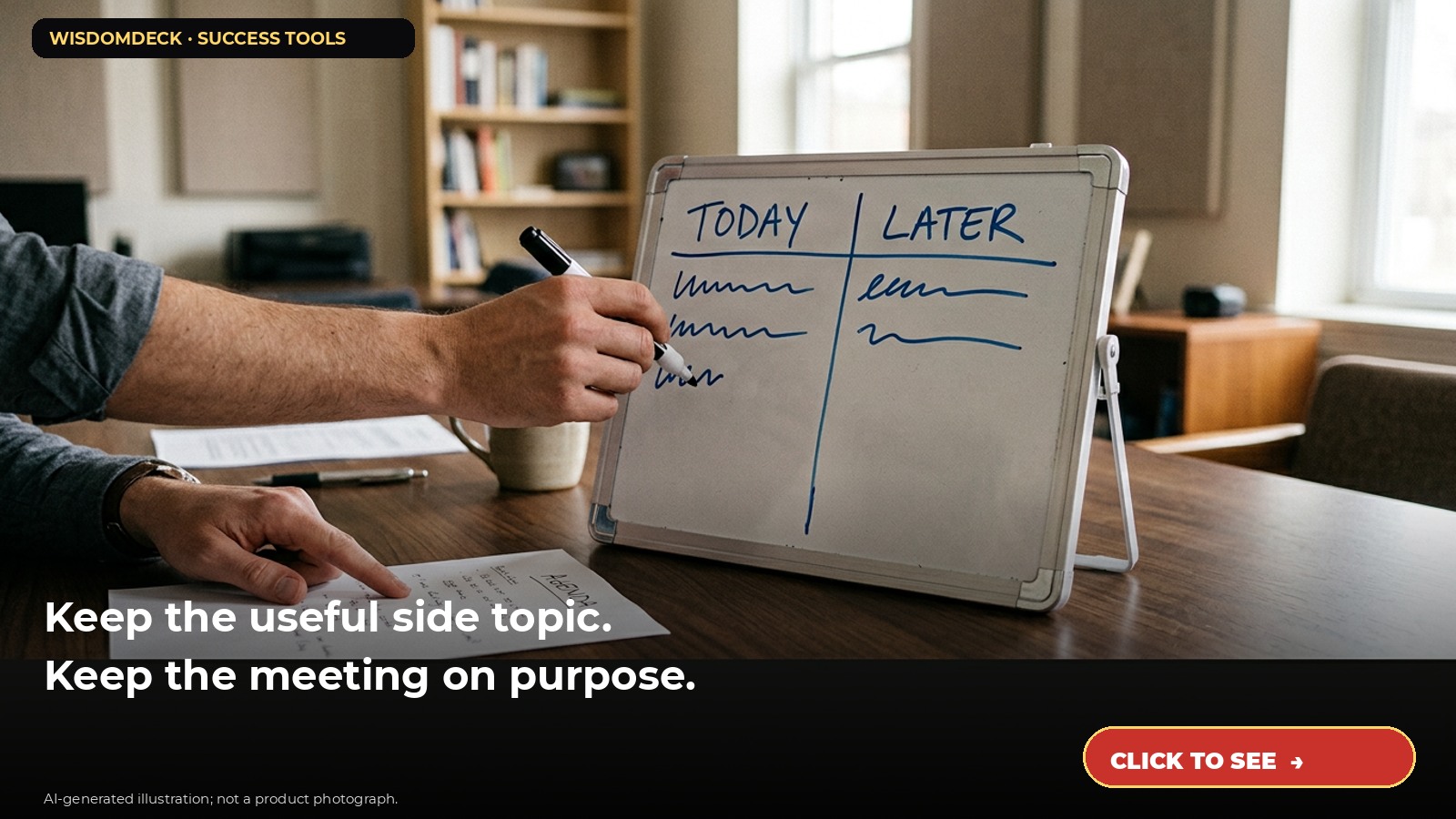
A small side-topic board gives the group a visible place to hold that issue. The important part is not the board itself. It is agreeing what gets captured and what happens before everyone leaves.
State the meeting outcome first
Write the decision or result the meeting is supposed to produce. “Choose a delivery date” is easier to protect than a general label such as “project update.” Without a defined purpose, it is difficult to distinguish a detour from necessary discussion.
For a small group, a compact dry-erase board may be readable. For a larger room or remote participants, use a shared format everyone can access. Do not choose a physical board that excludes part of the group from seeing or contributing to the list.
Capture the question without debating it
When an issue does not need to be resolved for the current outcome, summarize it in one sentence. Ask the person who raised it whether the wording preserves the concern. This takes more care than writing a vague keyword and moving on.
For example, “Who will answer customer messages after launch?” is a useful question. “Customer stuff” is not. The first can be assigned a next step without requiring the group to reconstruct the discussion.
Do not park a genuine blocker
Some apparent side topics change the decision in front of you. If the delivery date depends on an unresolved safety, staffing, or contractual requirement, that issue may belong in the main discussion. Test whether the meeting can responsibly reach its outcome without resolving or escalating it.
Use the board to manage sequence, not to silence inconvenient questions. The meeting lead should explain why an item is being deferred and allow the group to challenge that judgment when necessary.
Give each item a disposition
Before the meeting ends, review the captured questions. For each one, decide whether it needs an owner, another conversation, a place in the existing task system, or no action. Make “no action” an explicit decision rather than letting the topic disappear silently.
If action is needed, record a person who has agreed to take it and a useful next checkpoint. Assigning someone who is absent or lacks authority may create the appearance of follow-through without a workable commitment.
Move the record before erasing
A dry-erase board is temporary. Transfer agreed actions to the team’s normal record, and confirm that people can find them. Photograph the board only when workplace policy permits it and no confidential material is exposed.
Do not keep the same abandoned questions on a board indefinitely. An old list can become visual clutter while creating an unfair expectation that someone is handling it.
Who can skip the purchase
An existing shared document or sheet of paper can do the job. Skip a new board if the meeting problem is unclear authority, a missing decision maker, or no reason to meet. A writable surface cannot fix those conditions.
Try the method in one small discussion. Its useful outcome is a clear decision about every captured issue, not a longer list of things labeled Later.

Launch list
Be there on day one.
One email when the book opens on Kickstarter. Nothing else. Already reading the book? Your Cheat Sheet is at wisdomdeck.com/free.
Coming soon on 
The book itself — 40 laws in ten parts, 320 pages, each ending with The Work — is funded first on Kickstarter.