

A Weekly Goal Review That Ends With One Concrete Action
2 min read
AI transparency: This article was created with AI assistance. It is general organizational information, not a personal product review or professional advice.
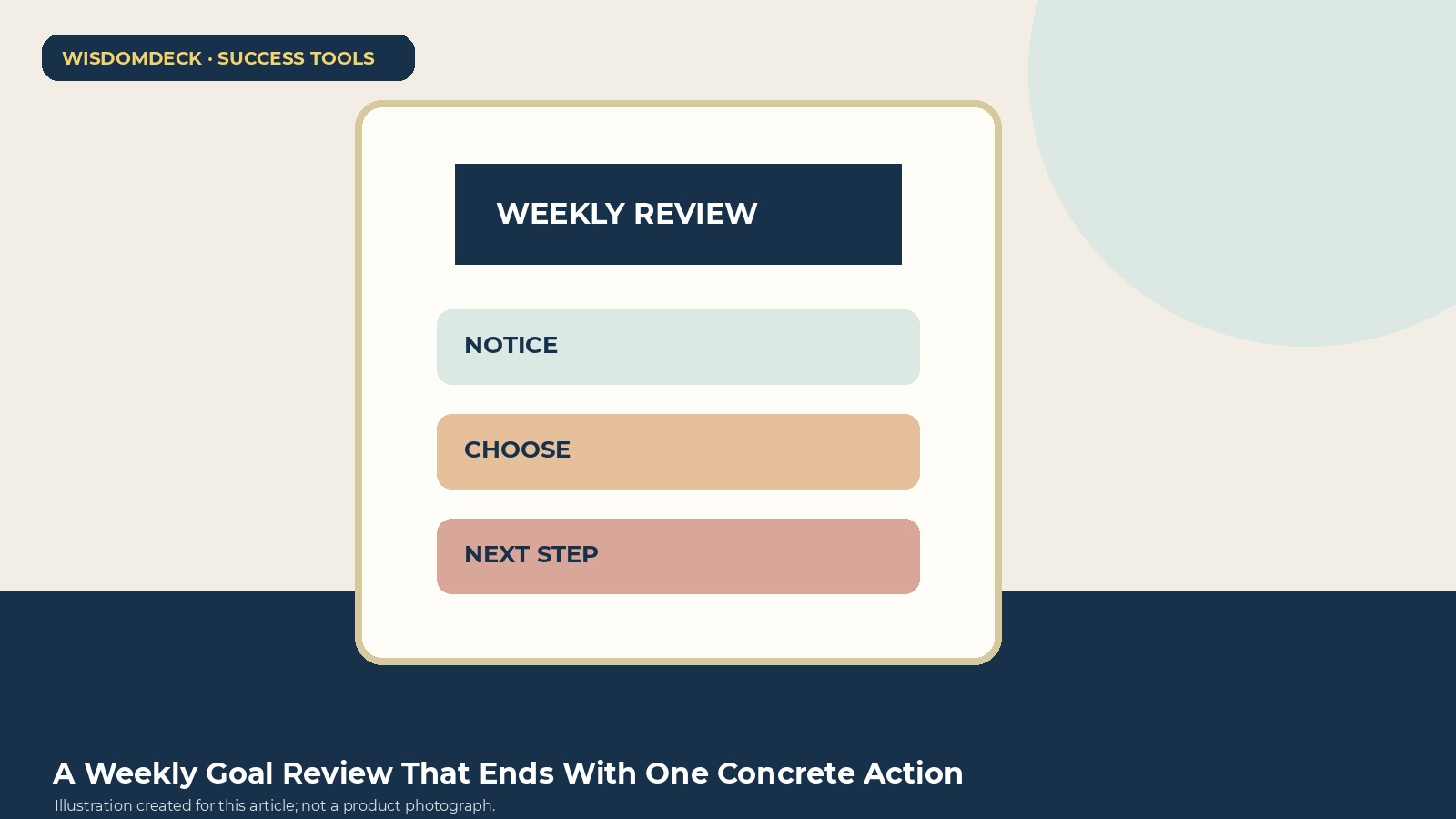
Plans often meet changing calendars, unexpected requests, and uneven energy. A weekly goal review gives you a moment to notice what happened and choose a realistic next action. It is not a test of discipline, and it does not need to become a long ritual.
Look at the week without grading yourself
Write down what moved, what stalled, and what changed. Use observable facts: “sent the draft for feedback” or “the appointment moved to next week.” Avoid turning a missed task into a judgment about your character. The review is useful only if it helps you decide what to do now.
 Worth reading on thisEssentialism by Greg McKeown — Doing fewer things, on purpose. The best argument for a shorter list you will read.Click hereto see it→
Choose a priority that fits the real week
Look at your existing commitments, deadlines, and available time before adding a new goal. If everything seems urgent, identify what has a real consequence or a fixed date. Ask for clarification when priorities conflict rather than quietly assuming you can do all of them.
Break a broad goal into a next action that can be started: open the project file and outline three sections, request the missing information, or schedule a conversation. If the action takes longer than a work session, define the first portion and where you will resume.
Make a when-and-where plan
Pair the action with a likely time and place. “Tuesday after the team check-in, at my desk, I will draft the outline for twenty minutes” gives you more to act on than “make progress.” Treat the duration as a starting estimate, not a promise that the whole task will be complete.
If your schedule changes, move the action deliberately or reduce its size. A plan that adapts is more useful than a perfect plan that makes you feel behind.
 Goes deeperAtomic Habits by James Clear — The clearest manual on making a habit small enough to survive a bad week. Pairs with almost everything on this site.Click hereto see it→
Clear one obstacle
Ask what could prevent the next step: missing information, an unclear decision, a crowded calendar, or a tool you cannot access. Choose one response, such as sending a question, reserving a short focus block, or asking a colleague to confirm ownership. If the obstacle is outside your control, record when you will reassess it.
End with a simple note to your future self
Write the next action, the place or file where you will begin, and one clue that tells you it is finished. Keep the note where you will see it. Then stop planning. You do not need to rebuild your entire system every week.
Try a ten-minute review once. Keep the questions that help you make a decision and discard the rest. Progress is not always dramatic; sometimes it is a clearer priority, a useful request, or a smaller step that you can actually begin.
Make room for changed priorities
If a new deadline or responsibility arrives, compare it with what you already planned. Decide whether to pause, delegate, ask for a revised deadline, or reduce the scope. Write down that decision so you are not silently carrying two incompatible plans. A realistic review helps you respond to the week you have, rather than the one you hoped would happen.
Two more books, and one tool

Launch list
Be there on day one.
One email when the book opens on Kickstarter. Nothing else. Already reading the book? Your Cheat Sheet is at wisdomdeck.com/free.
Coming soon on 
The book itself — 40 laws in ten parts, 320 pages, each ending with The Work — is funded first on Kickstarter.


