

An Expanding File for Home Records: Give Each Section a Job
2 min read
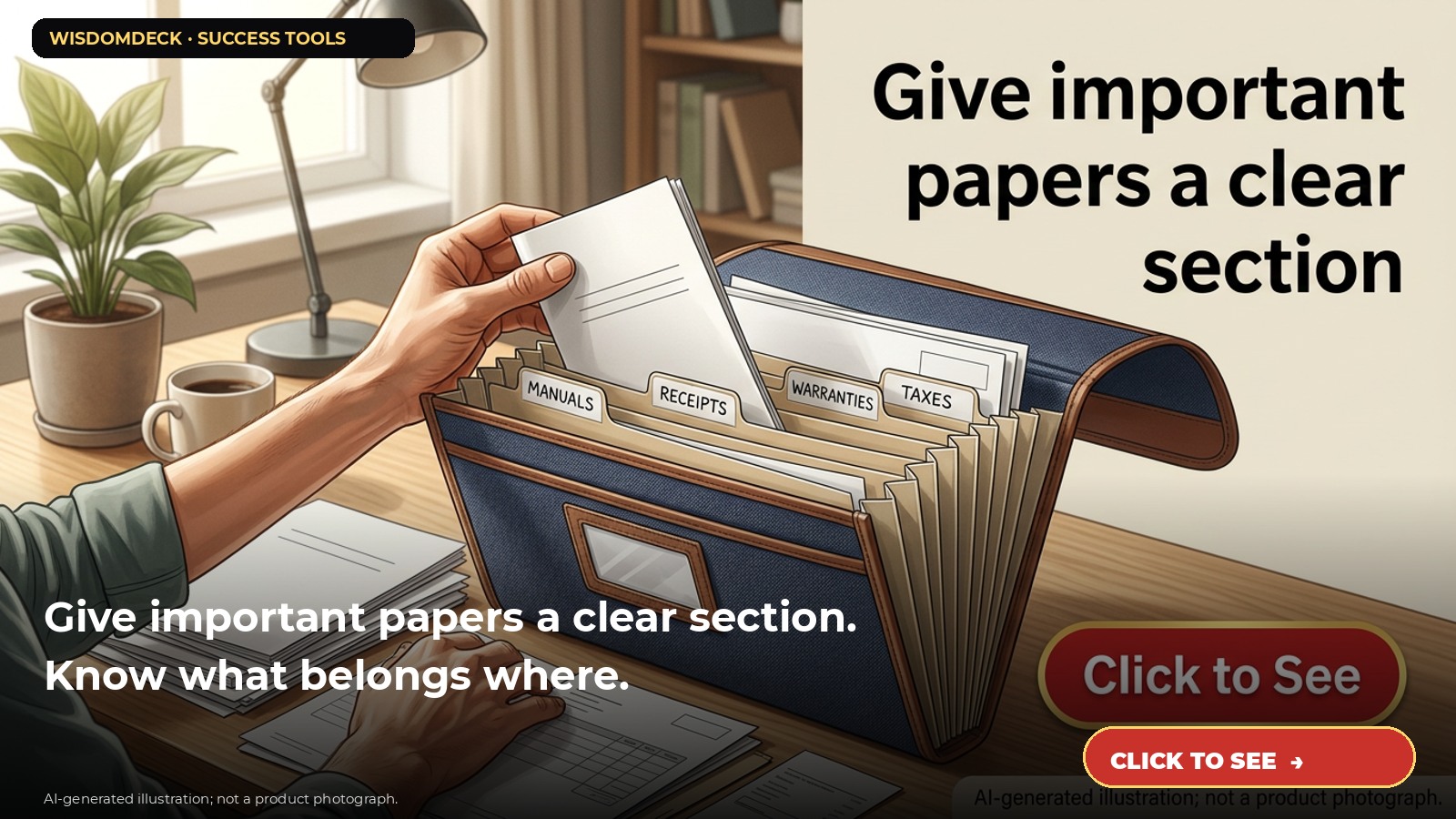
We may earn a commission if you buy through this link.
See Amazon Basics 13-pocket expanding file organizer on Amazon. Check the current listing before buying; existing supplies may be all you need.
Household papers become hard to manage when every receipt, manual, and appointment note is stored in one mixed pile. An expanding file can create separate sections, but a useful system begins with deciding which papers actually need to be kept and who is allowed to access them.
Choose the categories before labeling
Start with a quick inventory of the papers you currently use. Choose a few broad sections that match real tasks, such as home equipment, active warranties, tax-year documents, or pending forms. Do not create thirteen categories just because the organizer has thirteen pockets.
Keep active items near the front and completed reference records farther back if that makes retrieval clearer. Avoid combining papers with different retention, privacy, or access requirements. Follow any legal, workplace, financial, or agency rules that apply to specific documents; this organizer is not a records-retention guide.
Label for retrieval, not decoration
Use short labels that another household member can understand. A label such as “Appliance manuals” is more useful than a private shorthand. Keep labels consistent and use dates or model identifiers only when they help distinguish papers.
Place a brief index on the front if people need help finding the right section. Avoid writing account numbers, full identity details, passwords, or other sensitive information on a visible tab. Store the file in a location appropriate for the sensitivity of its contents.
Give every paper a next step
When adding an active document, decide whether it requires action, is waiting on someone, or is reference only. Put an upcoming task in the calendar or established task list rather than expecting the file itself to remind you. Remove papers when the task is resolved, subject to any required retention period.
For example, a receipt for a recently purchased appliance might sit with its manual and relevant warranty information while the household is setting it up. If a service visit is pending, record that follow-up in the calendar. Do not assume a receipt proves coverage or that every warranty term is the same.
Protect originals and private information
Some documents should remain in a secure place rather than in a portable folder. Keep original certificates, identity documents, or records with legal or financial importance according to appropriate guidance. Do not discard an original simply because a photocopy is filed.
If a household shares the file, agree who can add, remove, or view sensitive papers. Shred or dispose of unneeded records using a method suitable for the information, and check relevant retention instructions first.
Review the file on a schedule
Pick a modest review date, perhaps when a recurring household task already occurs. Remove duplicates and resolved paperwork only after checking whether it must be retained. Re-label pockets when the household’s actual needs change.
A file organizer is not useful if it becomes another unopened archive. If the papers are mostly digital, a secure existing system may work better. Try several sections with supplies you already own before buying a dedicated organizer.

Launch list
Be there on day one.
One email when the book opens on Kickstarter. Nothing else. Already reading the book? Your Cheat Sheet is at wisdomdeck.com/free.
Coming soon on 
The book itself — 40 laws in ten parts, 320 pages, each ending with The Work — is funded first on Kickstarter.


